
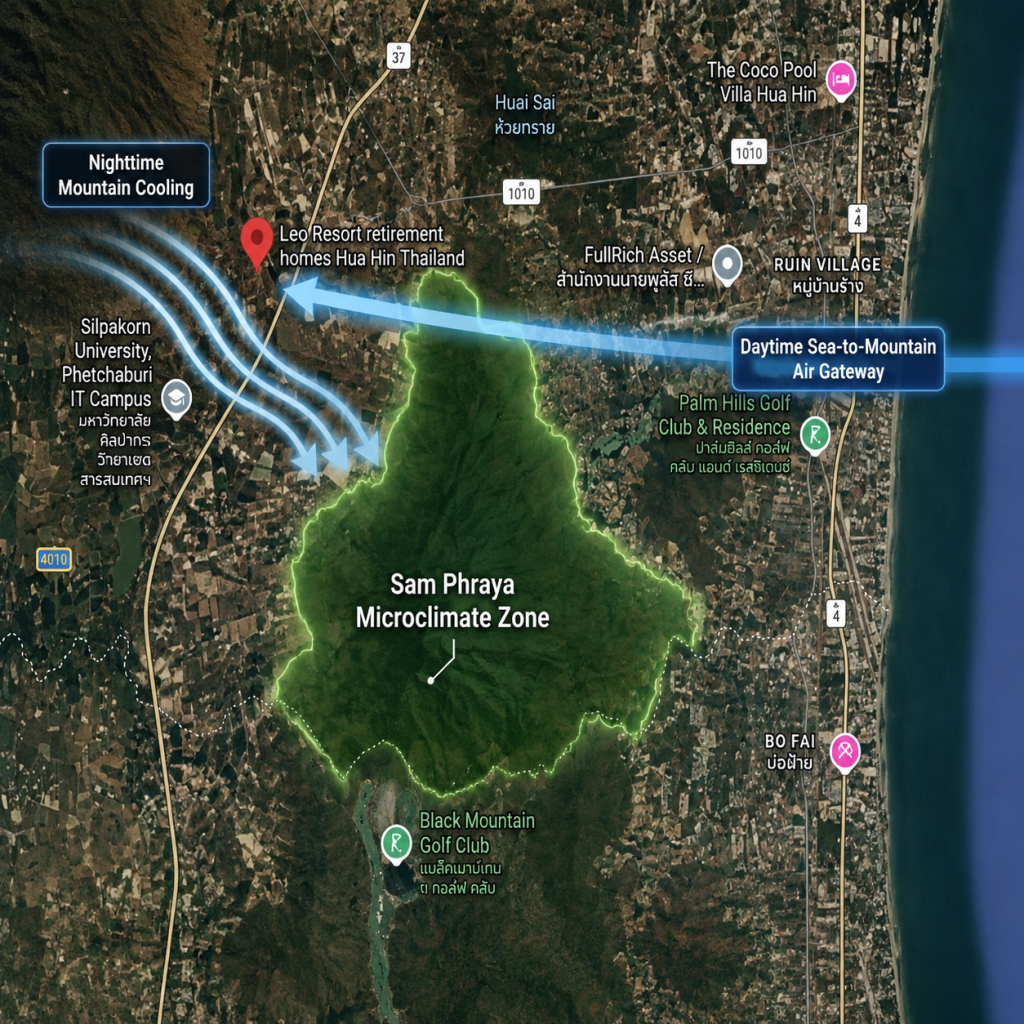
While the broader Prachuap Khiri Khan and Phetchaburi coastal regions enjoy far cleaner baselines than landlocked northern Thailand or industrial Bangkok, clear structural differences exist between high-density urban grids and open foothill valleys. This report details the microclimatological forces that drive air quality differences between downtown Hua Hin and the protected Sam Phraya area, focusing on the specific coordinates of Leo Resort.
The defining geographical advantage of the Sam Phraya foothill basin on the border of Hua Hin and Cha-Am is its placement within an unblocked air corridor. This layout creates what climatologists call a dynamic macro-ventilation gateway.
Daytime (Sea-to-Mountain Flow): As the midday sun heats the western mountain rock faces, warm air rises rapidly. This draws clean, cool marine air inward from the Gulf of Thailand, sweeping directly across the low-lying coastal plains and flowing cleanly up into the Sam Phraya foothills.
Nighttime (Mountain-to-Sea Flow): Conversely, at night, the mountain peaks cool down quickly. This dense, chilled air drains down the slopes, creating a fresh breeze that flushes back out toward the ocean.
Because there are no dense configurations of high-rise concrete tower blocks or heavy urban centers blocking this path, the Sam Phraya area acts as an open highway for this continuous two-way air cycle. The air is constantly moving, creating a natural flushing mechanism that prevents pollutants from settling or building up over the valley floor.
Topography directly determines how long airborne particulates (such as PM2.5 and PM10) stay trapped in an area. The microclimate around Leo Resort systematically reduces pollutant concentrations through three specific factors:
Downtown Hua Hin features high-density development along the primary Phetkasem transport corridor. Closely spaced commercial buildings create artificial "street canyons" that reduce wind velocity at ground level. This causes vehicle exhaust, road dust, and urban emissions to become trapped in stagnant pockets. In contrast, Sam Phraya's open landscape ensures wind speeds remain strong enough to constantly scatter and dilute particulate matter.
During cooler seasonal transitions, regional atmospheric inversions can trap a layer of cooler air close to the ground, holding seasonal agricultural smoke beneath it. However, the early afternoon mountain shading in the Sam Phraya basin shifts local thermal dynamics sooner than in coastal areas. This temperature drop triggers early air movement, disrupting the inversion layer and shifting smoke upward and away from ground level far more quickly than in stagnant urban zones.
The heavy canopy cover and natural green preserves surrounding Sam Phraya function as a live bio-filter. Dense plant life actively captures fine airborne dust on leaf surfaces while releasing pure oxygen and moisture through transpiration. This process naturally cleanses the air and helps keep humidity at comfortable, balanced levels.
| Air Quality Parameter | Coastal / Downtown Hua Hin | Sam Phraya (Leo Resort Microclimate) |
|---|---|---|
| PM2.5 / PM10 Exposure | Higher baseline levels due to concentrated vehicle traffic and localized urban heat islands. | Significantly lower baseline; consistently shielded from primary urban transport corridors. |
| Air Stagnation Risk | Moderate-to-high in central alleyways and built-up coastal areas behind high-rise developments. | Very low; continuously swept by the natural sea-to-mountain wind loop. |
| Thermal Particle Trapping | Prolonged; concrete surfaces retain heat, keeping the urban boundary layer low and trapping air. | Minimal; rapid evening cooling breaks down inversion layers to disperse particulates. |
| Natural Precipitation Wash | Standard rainfall clearing, often mixed with urban roof and street dust. | Enhanced; mountain-induced micro-showers provide frequent, clean washouts of the canopy. |
For retirees, making the switch to a highly ventilated microclimate provides major health benefits that protect long-term physical well-being:
A premium retirement environment requires excellent environmental design as its foundation. By utilizing the natural sea-to-mountain wind corridor, the Sam Phraya microclimate ensures that the air over Leo Resort remains clean, fresh, and continuously moving. Choosing to live in this open, highly ventilated valley means prioritizing your health, protecting your respiratory well-being, and enjoying a cleaner, more vibrant tropical lifestyle every single day.